



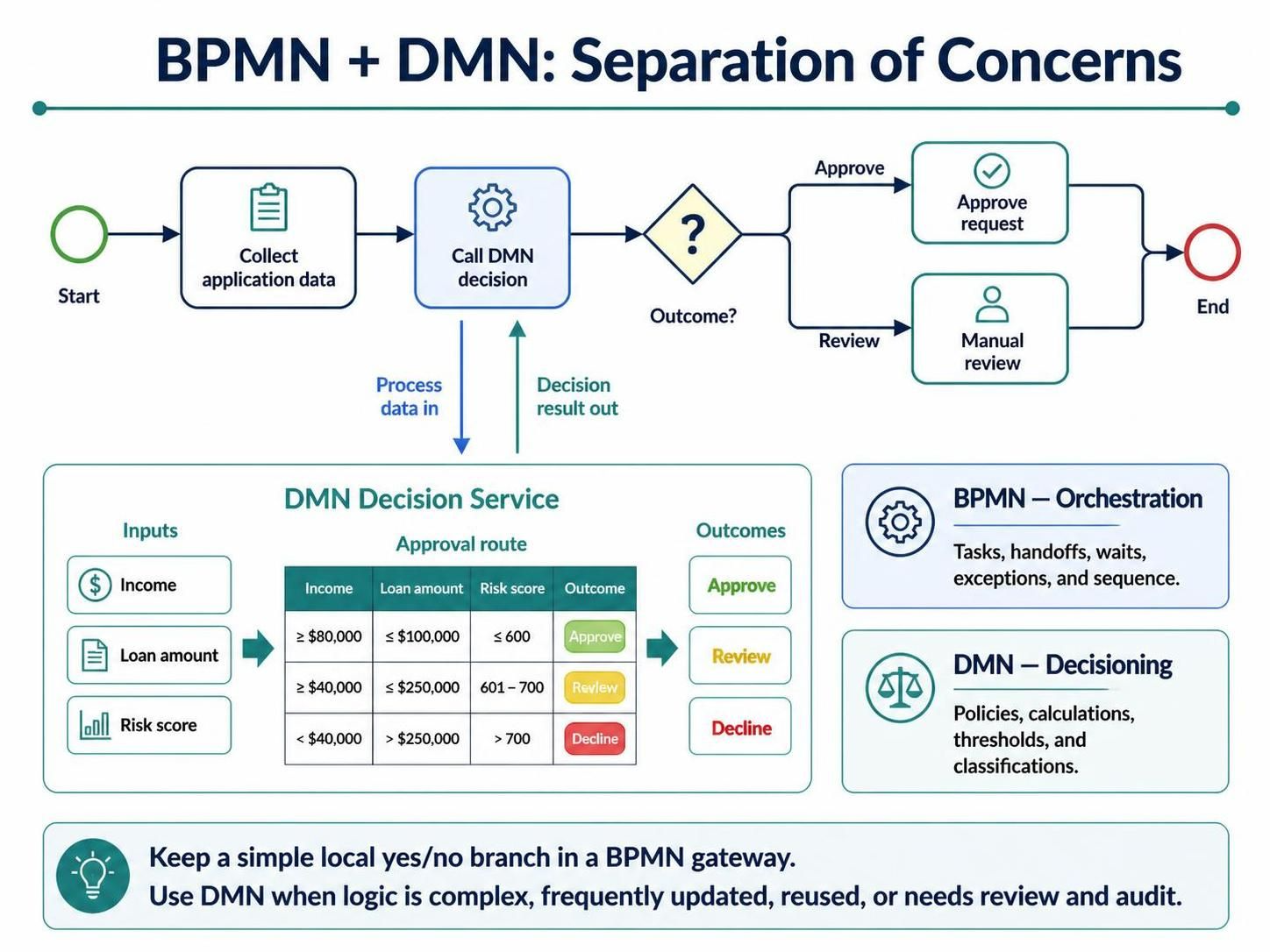
Effective business process automation requires a clear mental model of how different technologies interact. One of the most powerful architectural patterns in modern workflow management is the separation of concerns between BPMN (Business Process Model and Notation) and DMN (Decision Model and Notation). This tutorial explores the architecture shown in the “BPMN + DMN: Separation of Concerns” diagram, explaining how to structure complex loan approval workflows using Visual Paradigm’s modeling capabilities.
1. The Architecture of Orchestration vs. Decisioning
The core philosophy illustrated in the diagram is the distinct role each standard plays in a system. When designing a process in Visual Paradigm, you must decide where the “intelligence” of the system lives.
BPMN: The Conductor (Orchestration)
BPMN is responsible for the flow of the process. It manages the temporal sequence of events. As the diagram highlights, BPMN handles:
- Tasks: Actions like “Collect application data” or “Manual review.”
- Handoffs: Transferring work between actors.
- Waits & Exceptions: Managing time delays or error handling.
- Sequence: The logical path from Start to End.
DMN: The Brain (Decisioning)
DMN is responsible for the logic that determines the outcome of a task. It isolates business rules from process flow. DMN handles:
- Policies: The specific criteria for approval.
- Calculations: Mathematical operations (e.g., calculating a Risk Score).
- Thresholds: Boundary checks (e.g., “Is Income > $40,000?”).
- Classifications: Categorizing data into outcomes.
2. The Interaction Model: Invoke and Return
The diagram depicts a specific interaction pattern known as the Service Task invocation. This is how a BPMN process talks to a DMN decision service.
- Input Phase: The process reaches a “Call DMN decision” task. It gathers process data (Inputs) such as
Income,Loan amount, andRisk score. - Execution Phase: This data is passed to the DMN engine. The DMN logic evaluates the data against the “Approval route” table.
- Output Phase: The DMN engine returns a single decision output (e.g., “Approve”, “Review”, or “Decline”) back to the BPMN process.
This architecture ensures that if business rules change (e.g., the loan threshold increases), you can update the DMN model without having to touch or redeploy the BPMN process diagram.
3. Visualizing the “Approval Route” Decision Logic
In the DMN section of the diagram, we see a Decision Table. This is the most common way to represent complex logic in DMN. It maps inputs to outcomes based on a set of rules.
Decision Table: Approval Route

Inputs:
- Income (Currency)
- Loan Amount (Currency)
- Risk Score (Number)

Outputs:
- Outcome (String: Approve, Review, Decline)

Rules:
1. IF Income >= $80,000 AND Loan Amount <= $100,000 AND Risk Score <= 600 THEN Outcome = Approve
2. IF Income >= $40,000 AND Loan Amount <= $250,000 AND Risk Score is between 601-700 THEN Outcome = Review
3. IF Income < $40,000 AND Loan Amount > $250,000 AND Risk Score > 700 THEN Outcome = Decline
By using a DMN table, the logic is explicit and auditable. Stakeholders can read the table to verify if the rules match the company policy, without needing to understand the code.
4. Modeling Guidelines: When to Use Gateways vs. DMN
A common mistake in process modeling is overusing Decision Services for trivial checks. The diagram provides a crucial heuristic at the bottom:
- Keep it simple in BPMN: If you have a simple yes/no check that controls only one local branch (e.g., “Is the applicant over 18?”), use a BPMN Gateway. It keeps the diagram clean and the process self-contained.
- Offload to DMN when complex: Use DMN when the logic is complex, frequently updated, reused across multiple processes, or subject to strict audit requirements.
In the diagram, the diamond shape labeled “Outcome?” is a BPMN Gateway. It does not calculate anything itself; it simply directs the flow based on the string returned by the “Call DMN decision” task.
5. Conclusion
By adhering to the separation of concerns shown in this diagram, architects create systems that are more maintainable and easier to understand. The BPMN process focuses on the “how” and “when,” while the DMN decision service focuses on the “why” and “what.” This clear division allows business analysts to tune decision logic without disrupting the operational flow of the application.