

Welcome to a comprehensive guide on the architecture of a modern, privacy-first AI deployment strategy. In the current landscape of enterprise technology, the question is no longer if you should adopt AI, but how you can do so without sacrificing data sovereignty or overwhelming your IT team with technical debt.
The following tutorial breaks down the “Four-Pillar” architectural model designed to de-risk AI adoption. We will explore how this ecosystem binds software, infrastructure, and human capital together to create a seamless “Self-Host AI Total Solution.”
Pillar 1: The Integrated Software Suite Architecture
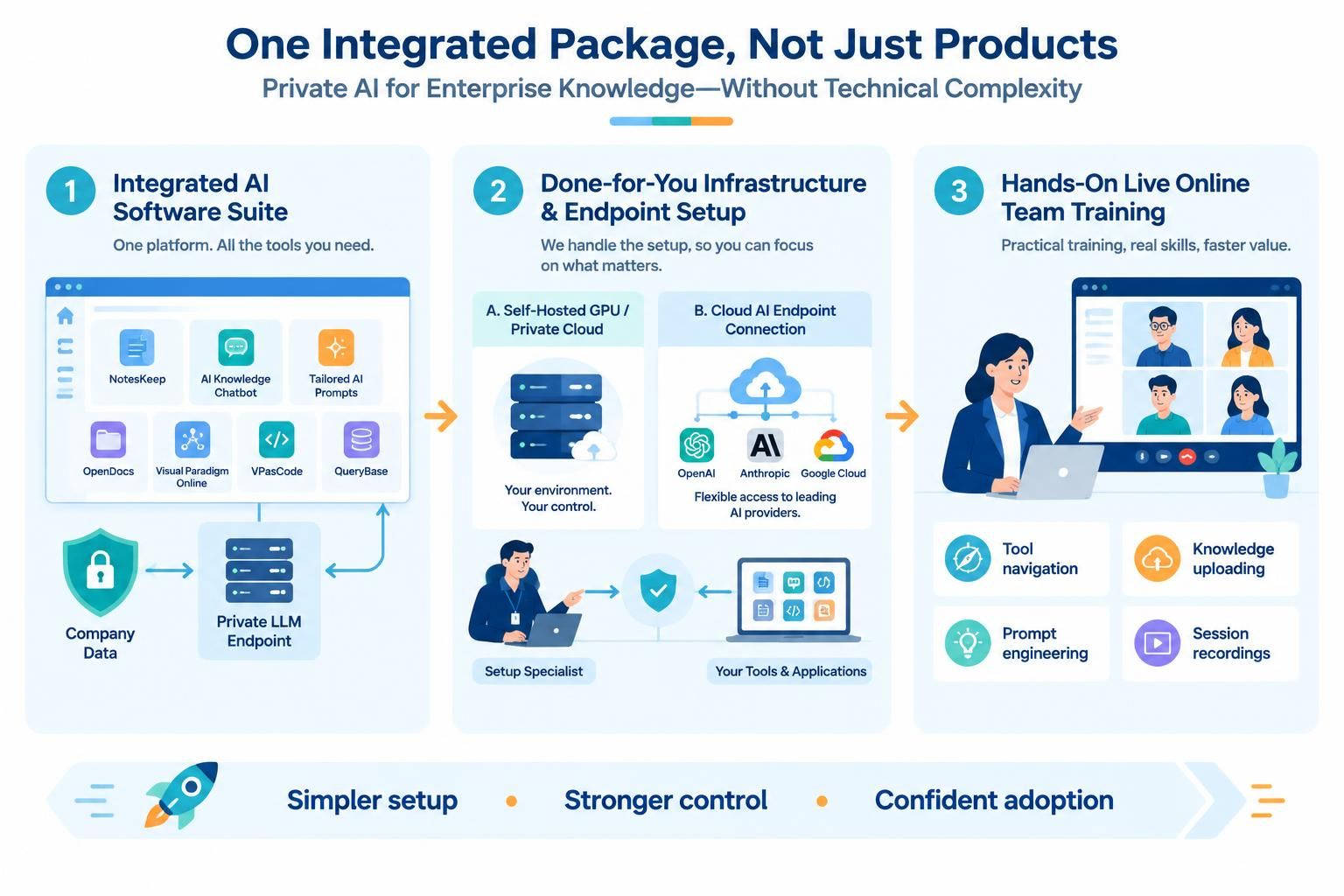
The foundation of this system is not a single isolated application, but a cohesive software suite designed to operate within a secure perimeter. Unlike traditional setups where tools are siloed, this architecture relies on a central Private LLM Endpoint that serves as the brain for all connected tools.
Here is the breakdown of the functional modules included in this suite:
- NotesKeep & OpenDocs: These modules handle the lifecycle of corporate assets. NotesKeep manages casual and structured notes, while OpenDocs serves as the publishing layer, ensuring knowledge is shared securely.
- AI Knowledge Analysis Chatbot: This is the primary interface for querying data. It operates on a “Grounded Generation” principle, answering queries strictly based on the data provided, minimizing hallucinations.
- Tailored AI Prompts: A specialized layer for document generation, allowing for precise outputs such as product specifications or meeting summaries.
- Visual Paradigm Online & VPasCode: These tools provide the visual and coding capabilities necessary for technical teams to model diagrams and generate code directly within the environment.
- QueryBase: A critical component for retrieving specific data points from your database.
How the Data Flow Works
In this architecture, data security is paramount. When a user interacts with the software suite, the request is routed to the Private LLM Endpoint. The system processes the request using the user’s private data context, ensuring that sensitive information never leaves the organization’s control.
Pillar 2: Infrastructure & Endpoint Flexibility
One of the most significant barriers to AI adoption is the complexity of infrastructure. This solution eliminates that friction by offering a flexible, “Done-For-You” infrastructure setup. The architecture supports two distinct deployment strategies, allowing enterprises to choose their preferred balance between maximum privacy and provider convenience.
Option A: Self-Hosted Dedicated GPU / Private Cloud
This approach prioritizes absolute data sovereignty. By deploying on hardware like AWS EC2 or a private on-premise cloud, the enterprise retains full ownership of the compute environment. The model runs in isolation, ensuring that no data is transmitted to third-party inference engines.
Option B: Cloud AI Endpoint Connection
For organizations that prefer to leverage established cloud providers, this architecture offers a bridge to industry leaders like OpenAI, Anthropic, or Google Cloud. Even in this mode, the solution manages the endpoint binding and configuration, ensuring that the connection is secure and optimized for the specific enterprise tools.
Pillar 3: The Human Factor & Live Training
Technology is only as effective as the people using it. This architectural model includes a dedicated “Human Layer” focused on adoption and skill transfer. Rather than leaving users to figure out the system alone, the solution provides Hands-On Live Online Team Training.
This training module covers three critical areas:
- Tool Navigation: Ensuring users understand how to access the suite effectively.
- Knowledge Uploading: Teaching best practices for ingesting corporate data into the system.
- Prompt Engineering: Guiding users on how to craft effective queries to get the most out of the AI.
This phase ensures that the “technical complexity” is removed from the user experience, allowing teams to focus on value creation from day one.
Pillar 4: Technical Advisory & Ongoing Support
The final pillar addresses the long-term viability of the system. By providing dedicated technical advisory and ongoing support, backed by a team with experience across 100+ applications, the solution ensures that the system remains robust and up-to-date.
This support structure is crucial for maintaining the integrity of the Private LLM Endpoint and ensuring that the software suite continues to evolve with the organization’s needs.
Conclusion: A Path to Confident Adoption
By integrating these four pillars—Software Suite, Infrastructure Flexibility, Human Training, and Technical Support—enterprises can achieve a “Self-Host AI Total Solution.” This approach transforms AI from a disjointed set of tools into a unified, secure, and manageable ecosystem.
The result is a clear pathway to Simpler Setup, Stronger Control, and Confident Adoption, allowing your organization to kickstart its AI journey without the technical hurdles that often stall progress.