

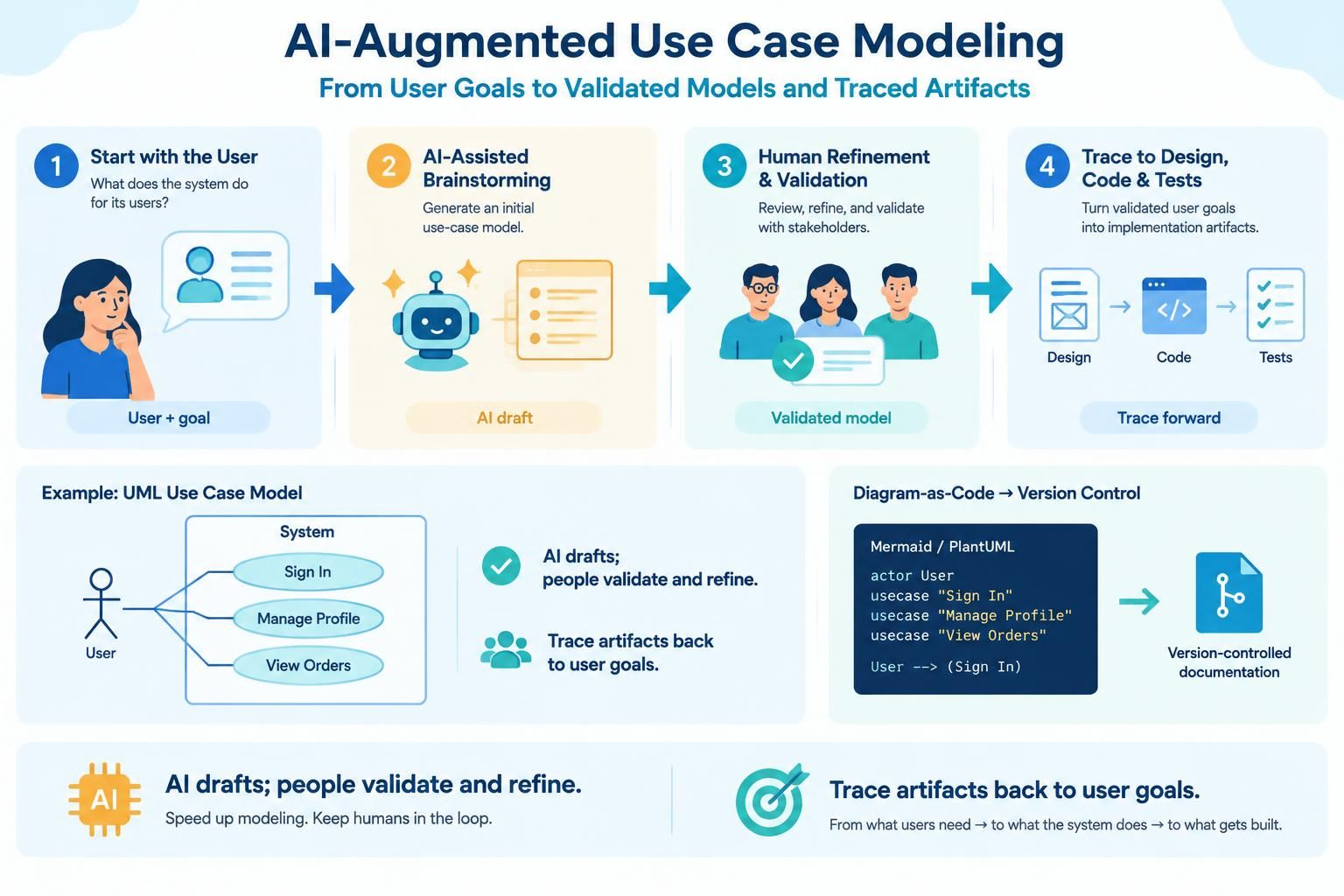
In the fast-paced world of software development, traditional requirements gathering often becomes a bottleneck. However, by integrating Artificial Intelligence into the modeling process, teams can transform use case modeling from a static documentation exercise into a dynamic, collaborative engine for Agile success. This tutorial explores how AI-assisted modeling specifically enhances Agile projects, identifies the project types where it shines, and clarifies the evolution of the methodology.
How AI-Powered Use Case Modeling Empowers Agile Projects
Agile methodologies prioritize iterative development, customer collaboration, and responsiveness to change. AI-augmented use case modeling aligns perfectly with these principles by shifting the focus from “drawing diagrams” to “discovering requirements.”
Accelerating the Discovery Phase
One of the primary challenges in Agile is maintaining the momentum of a Sprint while ensuring requirements are clear. AI tools allow Product Owners and Business Analysts to generate an initial draft of a use case model in minutes rather than days. By inputting plain-language descriptions of system goals, the AI suggests actors and use cases, effectively acting as a brainstorming partner that never sleeps. This rapid prototyping of requirements allows the team to hit the ground running.
Enhancing Traceability
A common pitfall in Agile is losing track of requirements amidst rapid code changes. AI-assisted modeling ensures that every use case becomes a central thread tying together design, code, and testing. The AI helps generate detailed “Flow of Events” for each use case, which can then be synchronized into test cases and sequence diagrams. This ensures that the “User Goal” remains the driving force behind every line of code written.
Facilitating Continuous Refinement
Agile relies on feedback loops. AI tools can analyze a draft model and suggest improvements, such as identifying opportunities for «include» or «extend» relationships that might have been missed. This allows the team to refine the model iteratively, validating the scope before committing to complex implementation details.
Which Project Types Are Most Suitable?
While use case modeling is universally applicable, certain project types benefit most from an AI-augmented approach:
- Complex Business Logic Systems: Projects with intricate workflows (e.g., financial systems, healthcare platforms) benefit from the AI’s ability to suggest standard patterns like authentication flows or error handling, ensuring no critical edge cases are overlooked.
- Stakeholder-Heavy Projects: When a project involves multiple departments or external clients, the AI acts as an objective synthesizer. It can quickly model different perspectives, helping to align diverse stakeholder needs into a cohesive system boundary.
- Systems Requiring Strict Compliance: Industries like banking or aviation require adherence to standards (such as UML 2.5). AI tools ensure that relationships and diagrams are standards-compliant, reducing the risk of technical debt or audit failures.
Is Use Case Modeling Compatible with Agile?
There is often a misconception that use case modeling is a “Waterfall” technique—something heavy and upfront that doesn’t belong in Agile. However, the perspective changes when we look at the intent of the model.
Traditional View: In a rigid environment, use cases are written as massive, detailed specifications before a single line of code is written. This is indeed antithetical to Agile.
Agile View: In an Agile context, use cases are “just enough” documentation to define the value being delivered. They are living documents that evolve with the product. The “Use Case-Driven” approach ensures that user stories are not just tasks, but validated user goals.
How AI Changes the Equation
If traditional use case modeling is a heavy lift, AI transforms it into a lightweight, iterative process. Here is how the nature of the work changes:
- From Manual Drafting to AI-Assisted Refinement: Instead of manually drawing shapes and connecting lines, the AI generates the structure based on natural language prompts. The human role shifts from “diagrammer” to “architect and validator.”
- From Static to Dynamic: AI tools can automatically update diagrams when requirements change. If a new actor is added, the AI can suggest new associations and relationships, keeping the model synchronized with the codebase.
- From Documentation to Code Generation: Modern AI tools (like VPasCode) allow for “Diagram-as-Code.” This means the use case model can be stored in a version control system (like Git), reviewed in pull requests, and integrated directly into the CI/CD pipeline.
Conclusion
AI-augmented use case modeling is not just a time-saver; it is a strategic enabler for Agile teams. By automating the tedious aspects of diagramming and ensuring traceability from user goals to test cases, teams can focus on what matters most: delivering value to the user. Whether you are building a complex enterprise system or a consumer-facing app, combining AI with the disciplined approach of use case modeling ensures that your software is built on a solid, user-centric foundation.