



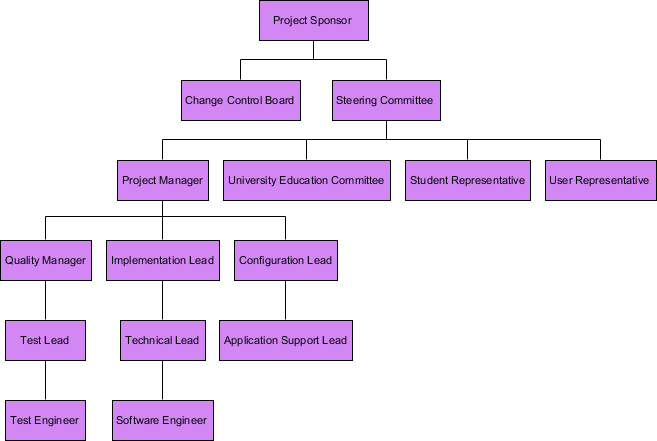
In the realm of project management, clarity regarding authority and responsibility is paramount. One of the most critical tools for visualizing this hierarchy is the Organizational Breakdown Structure (OBS). Often used interchangeably with an Organization Chart, the OBS provides a visual roadmap of the project’s stakeholders, defining who reports to whom and where decision-making power resides.
Visual Paradigm Desktop empowers teams to create these structures not just as static images, but as dynamic models. By leveraging the VPasCode tool and the AI Chartbot, project managers can rapidly generate complex hierarchies that align with industry standards like PMBOK (Project Management Body of Knowledge).
Understanding the Hierarchical Logic
The OBS is strictly hierarchical. Unlike a Work Breakdown Structure (WBS) which breaks down tasks, the OBS breaks down people and roles. The structure typically begins at the top with the Project Sponsor—the individual or group providing the funding and high-level direction. Below this, the structure branches out into governance bodies (like a Steering Committee) and the core project team.
In the context of Visual Paradigm, every box in your diagram represents a node in the organizational tree. The lines connecting these boxes represent reporting relationships. This visual syntax allows stakeholders to instantly identify:
- Authority Levels: Who has the final say on scope changes?
- Communication Paths: How should information flow from the bottom-up?
- Resource Allocation: Which department owns specific roles?
Step-by-Step: Modeling the OBS with VPasCode
Visual Paradigm’s VPasCode feature allows you to define the structure using a clean, text-based syntax. This method is significantly faster than manually dragging and dropping boxes, especially for large organizations.
To recreate the structure shown in our example, we will define the hierarchy using a simple parent-child relationship format. The top-level node is the Project Sponsor, followed by the governance bodies, and finally the execution team.
The VPasCode Syntax
When using VPasCode, indentation and spacing often dictate the hierarchy. Below is the raw syntax required to build the specific OBS structure provided in the reference material. You can input this directly into the VPasCode editor in Visual Paradigm.
Project Sponsor
    Change Control Board
    Steering Committee
        Project Manager
            Quality Manager
                Test Lead
                    Test Engineer
            Implementation Lead
                Technical Lead
                    Software Engineer
            Configuration Lead
                Application Support Lead
        University Education Committee
        Student Representative
        User Representative
Advanced Modeling with AI Chartbot
For users who prefer natural language over raw syntax, Visual Paradigm’s AI Chartbot offers a conversational interface to generate these diagrams. This feature utilizes Large Language Models (LLMs) to interpret your instructions and automatically structure the data.
Here is how you might prompt the AI to generate this specific structure:
- Open Visual Paradigm Desktop and navigate to the diagram workspace.
- Launch the AI Chartbot (usually found in the sidebar or via a specific “AI” menu option).
- Input the following prompt: “Create an Organizational Breakdown Structure. Top level is Project Sponsor. Directly below are Change Control Board and Steering Committee. Under Steering Committee are Project Manager, University Education Committee, Student Representative, and User Representative. Under Project Manager are Quality Manager, Implementation Lead, and Configuration Lead. Further down the chain, Quality Manager leads Test Lead who leads Test Engineer. Implementation Lead leads Technical Lead who leads Software Engineer. Configuration Lead leads Application Support Lead.”
- Review the generated diagram and refine as necessary using the layout tools.
Interpreting the Structure: Governance vs. Execution
Looking at the generated diagram, we can see a clear distinction between Governance and Execution.
The Change Control Board and Steering Committee sit at the top of the operational tree. These bodies are responsible for high-level approvals, budget oversight, and scope management. They do not typically engage in day-to-day coding or testing.
Conversely, the Project Manager sits as the pivot point for the execution layer. Under the PM, we see specialized leads: Quality, Implementation, and Configuration. This separation of duties is a best practice in project management known as “Segregation of Duties.” It ensures that the person building the software (Implementation Lead) is not the same person testing it (Quality Manager), thereby reducing risk.
Conclusion
Building an Organizational Breakdown Structure is more than just drawing boxes; it is an act of defining the project’s culture and workflow. By using Visual Paradigm’s combination of VPasCode for speed and AI Chartbot for ease of use, teams can ensure their governance models are accurate, up-to-date, and ready for implementation.