



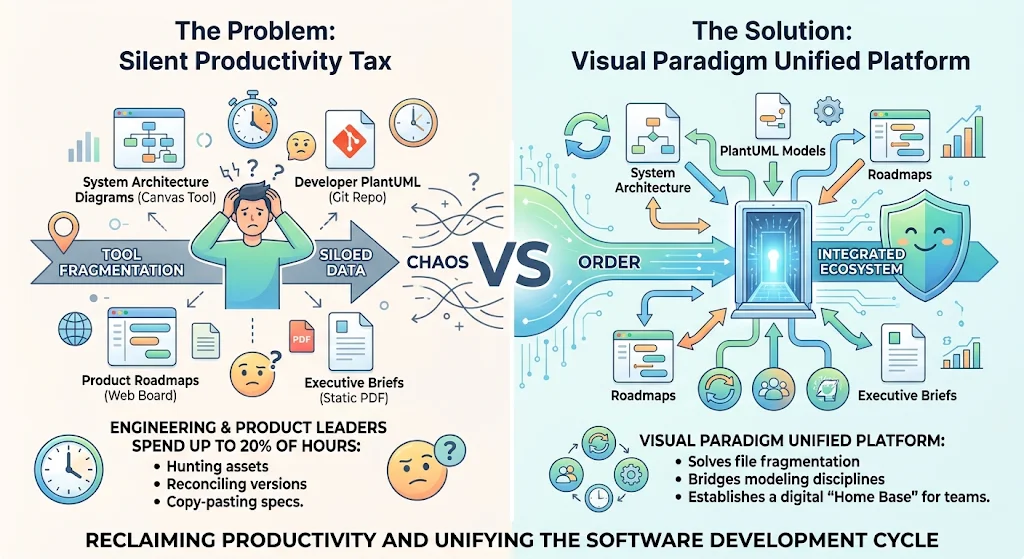
In the modern landscape of software engineering, teams often suffer from a “silent productivity tax.” This phenomenon is not caused by a lack of talent or resources, but rather by extreme tool fragmentation. When engineering and product leaders are forced to jump between disparate systems to manage their workflow, the efficiency of the entire organization suffers.
The Problem: The Cost of Tool Fragmentation
Imagine a typical development environment where no single source of truth exists. Instead, critical assets are scattered across a chaotic ecosystem:
- System Architecture Diagrams: Often reside in disconnected canvas tools, isolated from the codebase.
- PlantUML Models: Developer-authored files sit in Git repositories, visible only to coders but inaccessible to stakeholders.
- Product Roadmaps: Live on separate web boards, disconnected from the technical reality.
- Executive Briefs: Exist as static PDFs, which are prone to versioning errors and cannot be easily updated.
According to industry observations, this fragmentation forces leaders to spend up to 20% of their working hours on non-value-added activities, such as:
- Hunting down where a specific asset lives.
- Reconciling outdated versions of documents.
- Manually copy-pasting specifications between systems.
The Solution: A Unified Ecosystem
The Visual Paradigm Unified Platform addresses this challenge by acting as an integrated ecosystem designed to solve file fragmentation. It bridges distinct modeling disciplines and establishes a digital “Home Base” for technical teams.
Step 1: Centralizing the Workflow
The core philosophy of the solution is to replace “Chaos” with “Order.” Instead of siloed data, the platform allows for a seamless flow of information. When you model System Architecture, that data should not just be a static image; it should be a living entity that feeds into Roadmaps, Executive Briefs, and other documentation.
Step 2: Bridging Disciplines
In a unified platform, the gap between developers (PlantUML) and product managers (Web Boards) is bridged. The platform supports a workflow where:
- System Architecture diagrams are not just drawings; they are executable models.
- PlantUML Models are integrated directly into the workspace, ensuring developers stay in sync with the visual representation.
- Roadmaps are linked to technical capabilities, ensuring that what is planned is technically feasible.
Key Technical Concepts in Unified Modeling
To effectively utilize a platform like Visual Paradigm, one must understand the shift from static documentation to dynamic modeling.
1. The Digital Home Base
Think of the platform as the central hub of a solar system. The System Architecture is the sun. All other artifacts—roadmaps, executive briefs, and code snippets—orbit around it. This ensures that if you update the architecture, every dependent document is automatically updated.
2. Version Control & Reconciliation
One of the biggest issues in fragmented tools is “version drift.” By unifying the platform, you eliminate the need to manually reconcile versions. The platform maintains the integrity of the data throughout the Software Development Life Cycle (SDLC).
3. The “Home Base” Workflow
Establishing a digital “Home Base” means that stakeholders no longer need to ask “Where is the latest version?” or “Who has the PDF?”. The answer is always the unified platform, providing a single source of truth.
Conclusion: Reclaiming Productivity
The transition from a fragmented toolset to a unified platform is not just a software upgrade; it is a productivity strategy. By solving file fragmentation and bridging modeling disciplines, teams can reclaim the 20% of hours previously lost to administrative chaos. The result is a streamlined, ordered workflow where the focus returns to what matters most: building great software.